
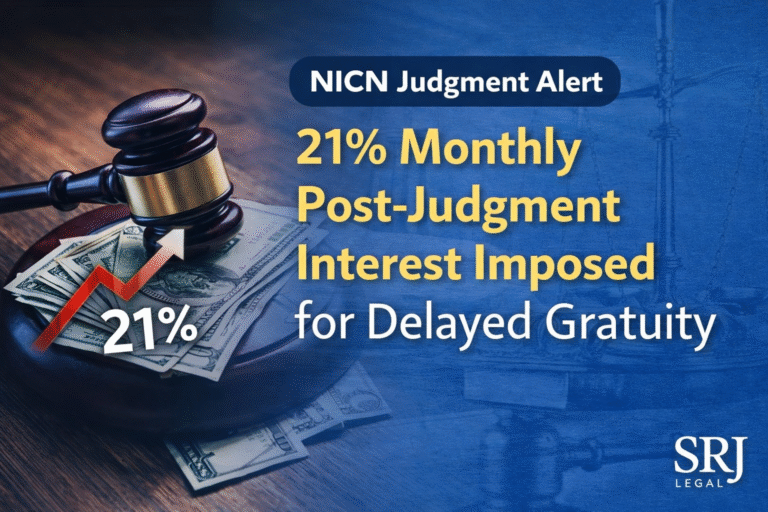
The National Industrial Court of Nigeria (NICN) delivered a landmark employment law decision imposing 21% monthly post-judgment interest on Ecobank Nigeria’s delayed gratuity payments, following a finding that it wrongfully withheld an employee’s earned benefits. The Court held that prolonged non-payment of gratuity amounted to an unfair labour practice and justified a discretionary departure from standard interest rules. This judgment carries significant implications for employers, HR leaders, and in-house counsel managing exit obligations and employment risk in Nigeria.
Court: National Industrial Court of Nigeria (Enugu Division)
Case: Adewale Aina v. Ecobank Nigeria Plc (NICN/EN/38/2021)
Date: December 16, 2025
The National Industrial Court of Nigeria (NICN) has delivered a judgment with significant implications for employers—particularly financial institutions—on the consequences of delaying gratuity and terminal benefit payments.
In Adewale Aina v. Ecobank Nigeria Plc, the Court not only upheld the Claimant’s entitlement to gratuity but imposed a 21% simple post-judgment interest per month, a rate designed to discourage delay and neutralise any financial benefit derived from withholding employee entitlements.
This alert highlights the commercial lessons, not just the legal outcome.
The Core Issue: Gratuity Entitlement Below 10 Years
The Claimant served Ecobank for 9 years and 10 months before his employment was terminated. Ecobank argued that gratuity was payable only after 10 full years of service under its Human Resources Policies.
The Court disagreed.
Applying a holistic interpretation of the Ecobank Human Resources Policies and Procedures (April 2016), the NICN held that Clause 11.2.4(b) created an exception to the 10-year benchmark where termination occurred without employee fault. In such cases, gratuity is payable on a prorated basis.
Key insight for employers:
Internal HR policies will be construed against the drafter, especially where ambiguity affects employee exit rights.
A Sensitive but Critical Finding: “Fraudulently Trading” with Gratuity
What distinguishes this judgment is the Court’s explicit finding that Ecobank had been “fraudulently trading” with the Claimant’s gratuity by withholding payment for years.
The Court treated the failure to pay earned emoluments as:
- a violation of the employee’s property rights,
- an affront to human dignity, and
- a classical example of unfair labour practice under section 254C(1)(f) of the Nigerian Constitution.
This language signals a shift: prolonged non-payment of terminal benefits may now attract judicial censure, not just monetary liability.
Why the Court Imposed 21% Monthly Post-Judgment Interest
Ordinarily, interest awards follow court rules prescribing annual rates. In this case, however, the Court exercised its discretion—relying on the National Industrial Court Act and the NIC Rules—to impose monthly interest.
The justification was commercial and deliberate:
- Ecobank is a commercial bank, not a distressed employer.
- Withheld gratuity effectively became cost-free capital.
- Without a punitive interest regime, delay would remain economically rational.
The Court therefore declined pre-judgment interest but imposed a heavy post-judgment interest to compel prompt compliance.
Business takeaway: Post-judgment interest is no longer symbolic—it is now a financial enforcement tool.
Why This Judgment Matters for Employers and HR Leaders
This decision is a warning, not a one-off anomaly. Employers should note that:
- HR policies are enforceable contracts, not discretionary manuals.
- Delayed gratuity payments can trigger constitutional-level scrutiny.
- Filing post-judgment applications does not stop interest from running unless a stay is granted.
- Courts are increasingly aligning Nigerian employment law with international best practices.
Final Thought
The NICN is making it clear: exit obligations are not optional, and delay is no longer cheap. For employers, the smarter strategy is compliance, not deferral.
This alert summarises the implications only. The full judgment provides deeper guidance for organisations reviewing their exit, severance, and HR risk frameworks.
For advisory support on employment exits, HR policy structuring, or judgment-risk management, contact SRJ Legal.

