
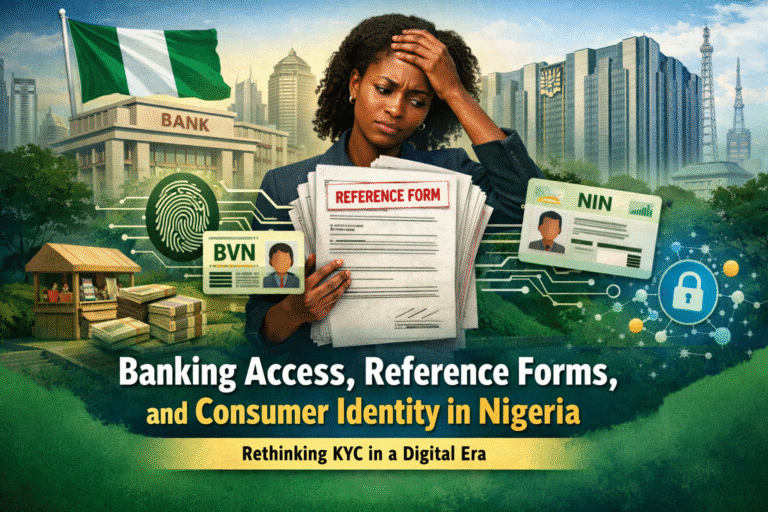
Consumer identity in Nigeria’s digital era has evolved significantly, driven by systems such as BVN and NIN. Yet, reference forms, still embedded in bank account opening processes, continue to hinder access to banking products and slow financial inclusion.
Background
An SME supplier of NAFDAC-approved and SON (Standards Organization of Nigeria) MANCAP-compliant commodities secured a supplies arrangement with a supermarket. But she is asked to open a business account to receive payments.
She walks into a bank. Her identity is already established through BVN and NIN used in her personal account opening forms. Her business is not only traceable but CAC certified. Her transaction purpose is clear.
Yet, she must ask two CAC established businesses to fill a bank account opening reference form. After three rounds of queries on the submitted reference form including dormant account, and irregular signatures, the process stalls. Fatigue sets in. She begins to question the decision to even open the account.
In a system designed to enable commerce, the reference form process does the very opposite.
Here’s why it matters
Banking access is no longer just a compliance issue. It is a commercial and economic question.
Nigeria invested significantly in digital identity infrastructure. The BVN (Bank Verification Number) and NIN (National Identity Number) systems now allow individuals to be identified, verified, and tracked across the financial system with a level of certainty unknow to the predecessor customer due diligence regimes (also known as KYC).
Identity today is:
- biometric
- traceable
- system-linked
In any case, reference forms, a product of an earlier KYC era, continue to shape onboarding processes. Reference forms belong to a time when identity was social and speculative, not digital.
Shift from social identity to system identity
Reference forms were built on a simple premise, “someone who knows you can vouch for you.” Today, that premise has changed.
The financial system already knows the customer through:
- BVN-linked data
- NIN integration
- Interoperable transaction history and traceability
The question is no longer who knows the customer. It is whether the system itself is trusted to know the customer.
Where the disconnect lies
- Duplication within the system
A customer already verified within Nigeria’s banking system is still required to produce references to open another account, sometimes even within the same bank. This raises a structural concern: the system is not fully aligned with its own identity infrastructure.
- Friction disguised as compliance
In practice, some bank officers offer to “help” customers obtain reference forms.
This reveals a deeper issue, reference form as a KYC process is procedural, a mere box ticking, that reduces access to finance
If a requirement can be informally arranged to complete onboarding, its value as a risk control tool is questionable.
- Impact on SMEs and financial access
For SMEs and MSMEs, onboarding delays are not neutral. They affect:
- cash flow timelines
- supplier relationships
- business growth decisions
For individuals without strong social networks, reference form requirements can become exclusionary, even where identity is independently verifiable. This is where compliance intersects with financial inclusion.
Global direction and local best practice
Across modern financial systems, onboarding is evolving toward:
- risk-based KYC frameworks
- digital identity verification
- seamless account opening processes
- inclusion-driven design
Against this backdrop, reference forms in Nigeria’s banking sector appear increasingly out of step with global best practice.
Risk question we rarely ask
What risk does a reference form actually mitigate? When referees typically:
- bear no clear legal liability
- provide limited verifiable assurance
- do not improve credit assessment outcomes
Use of reference forms in our banking system creates a process gap that is rigorously time-consuming but delivers limited measurable risk value.
What you must know
This is not a question of whether banks can require reference forms. Banks can until a Federal High Court restricts or strikes down the use of reference forms.
The real issue is whether such requirements remain proportionate, relevant, and aligned with current identity systems?
Opportunity for alignment
Nigeria’s banking system has already built a robust BVN and NIN infrastructure that enable financial transaction information traceability.
The next step is alignment. Moving from a reference-based onboarding to data-driven, risk-based identity verification in line with the Customer Due Diligence and Enhanced Customer Due Diligence Frameworks.
A shift that will reduce onboarding friction, improve access to banking services, enhance SME participation, strengthen customer experience, and reinforce institutional credibility.
Closing insight
Reference forms were once useful. But usefulness evolves. The question is no longer whether they served a purpose in the past. It is whether they still serve a meaningful purpose today.
If a process adds friction without adding value, it deserves to be reconsidered. Because in a modern financial system, access should be driven by verified identity and risk insight, not by legacy processes that no longer reflect how trust is built.